
Beyond the Tool: What AI is teaching legal leaders about curiosity, culture and change
Artificial Intelligence is rapidly becoming part of the legal operating environment. Yet much of the conversation remains focused on technology: which tools to choose, how quickly to implement them, and what the future might hold.
This focus is understandable, but it risks overlooking a more important question. Why do some legal teams appear to be making meaningful progress with AI while others remain stuck in experimentation? The answer may have less to do with technology than many assume.
During GCWN Frontline's first global webinar, “AI and the GC: Pressure, fear and what actually works” attended by over sixty senior in-house counsel, participants revealed something surprising. AI adoption itself is no longer the primary challenge. Most legal leaders are already using AI in some form. The challenge now is turning experimentation into capability and capability into meaningful organisational change.
The legal teams making the greatest progress are not necessarily those with the most sophisticated tools. They are ofen those with cultures that encourage curiosity, experimentation and learning. In that sense, AI is not creating innovative organisations but revealing them.
Your are not being left behind
Much of the current AI conversation is driven by a sense of urgency. Attend any legal technology conference and it can quickly feel as though every organisation has already solved the AI challenge. Vendors present increasingly sophisticated solutions, peers share compelling use cases and headlines suggest transformation is happening everywhere.
The result is a growing perception gap. Many legal leaders quietly assume they are falling behind.
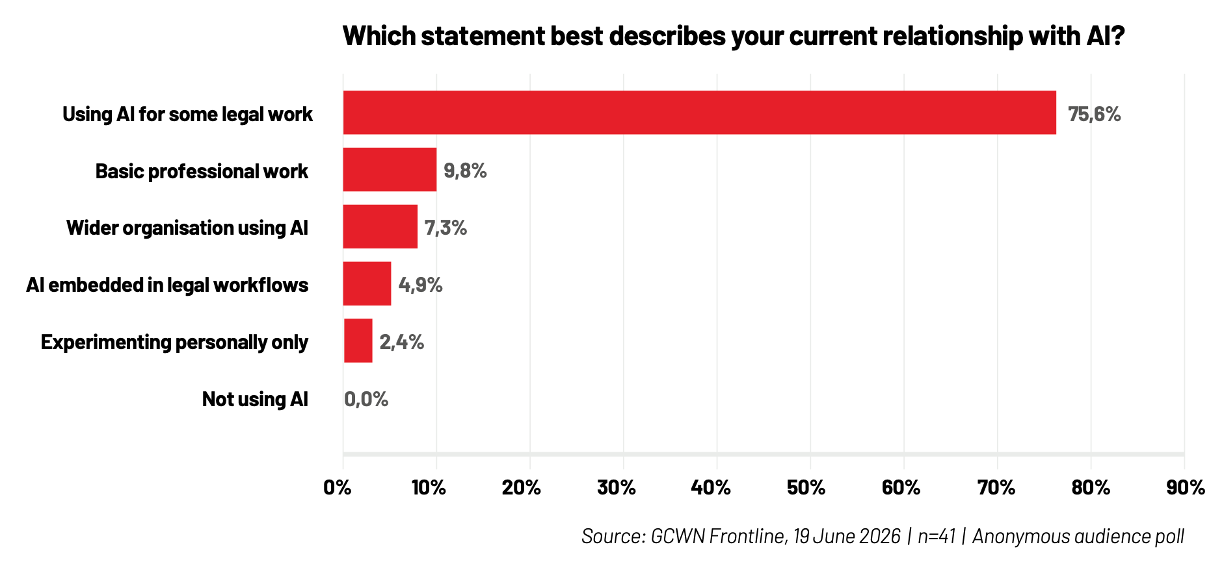
Yet the data emerging from the GCWN community suggests a different reality. More than three quarters of participants reported already using AI for legal work, yet only a small minority considered AI to be fully embedded within legal workflows. Adoption is widespread but maturity remains low.
This distinction matters.
The challenge facing most legal teams is no longer whether to engage with AI. That decision has largely been made. The challenge is how to move beyond isolated experimentation towards meaningful organisational capability.
On The Fear Gap Fergus Speight | GC, Zilo
Even working inside a technology business at the frontier of AI does not eliminate the fear of being left behind. Zilo has around 110 engineers, including a dedicated AI team building its own models. Yet Fergus described his own early response to AI as one of intimidation. The sheer volume of discussion can create the impression that everyone else understands more, has implemented more and is moving faster. At events, the questions come quickly: What are you using? What have you implemented? Haven’t you done that yet? Fergus’s initial reaction was remarkably candid: “Everybody else is miles ahead of me — how will I ever catch up?” His experience since then has challenged that assumption. Much of what is presented as an AI-native future remains some distance away. Most organisations are still becoming AI-enabled: using available tools to improve existing work. Recognising that distinction can itself reduce the pressure. The objective is not to catch an imaginary frontrunner, but to keep learning and moving.
Most organisations may benefit by focusing on certain key questions:
Which tools are worth investing in?
How do we balance experimentation with risk?
How do we maintain quality and judgement?
How do we bring our teams along?
In esssence, these are not technology questions. They are leadership questions.
The legal profession is often characterised as risk-averse. Yet lawyers routinely operate in conditions of uncertainty. Every significant transaction, dispute, regulatory decision or board discussion involves incomplete information and competing interpretations.
AI introduces a new form of uncertainty, but uncertainty nonetheless. The organisations moving fastest appear not to be those with the greatest certainty. They are those most willing to learn while moving.
Culture eats technology for breakfast
When organisations struggle with AI implementation, the instinct is often to search for a technical solution. A better platform, vendor, or model. Yet the strongest examples shared during the discussion pointed elsewhere, and the real challenge is often behavioural.
Many legal teams are attempting to solve an adaptability challenge through technology procurement. But adoption rarely happens because a new tool appears. It happens because people change how they think and work.
From Failure to Five Minutes
Laura Todd | Legal Director, Utility WarehouseUtility Warehouse's legal team began exploring AI around three years ago. Its first attempt failed. Rather than disguising that failure, Laura saw it as an important part of moving towards effective implementation. Around a year later the team tried again, this time with a much simpler objective. There would be no grand transformation programme. Laura started off small, and challenged her team to just use the AI tool for five minutes every day to build a daily practice, and share what they had tried in the team chat. Momentum followed behaviour. People saw colleagues experimenting, use cases began circulating and confidence grew. Then one junior lawyer suggested a leaderboard and prize. It sounded frivolous—until it worked. One of the team’s biggest AI sceptics became their highest user because, as Laura recalled, “they couldn't bear the thought of not being top of the leaderboard.” That same lawyer became one of their strongest AI advocates. The lesson was less about technology than culture: experimentation became visible, social and even playful.
Here is an important truth about culture change: people are heavily influenced by what they see their peers doing. Adoption is fundamentally social and people rarely change because technology arrives. They change when they see trusted colleagues using it successfully.
This is particularly relevant in legal teams, where professional identity is often built around expertise, precision and judgement. AI can feel threate- ning because it appears to challenge many of the skills lawyers have spent years developing.
The teams making progress are not ignoring these concerns. They are creating environments where people feel safe enough to explore them.
Don’t let the tail wag the dog
One of the most common mistakes in AI implementation is allowing the technology to dictate the agenda. Organisations become captivated by what the tool can do rather than focusing on the problems they are trying to solve. This often leads to a familiar pattern: a solution searching for a problem.
A more effective approach begins with the work itself. Where are the bottle- necks? Where are the repetitive tasks? Where is valuable legal expertise being consumed unnecessarily? Where is the greatest friction in the opera- ting model?
It follows that some of the most sophisticated insights from a discussion on AI are not technological at all. They are operational. Rather than viewing AI as a standalone initiative, we need to approach it through the lens of legal operating model design. This starts by understanding the nature of the work.
Utility Warehouse's volume × risk model
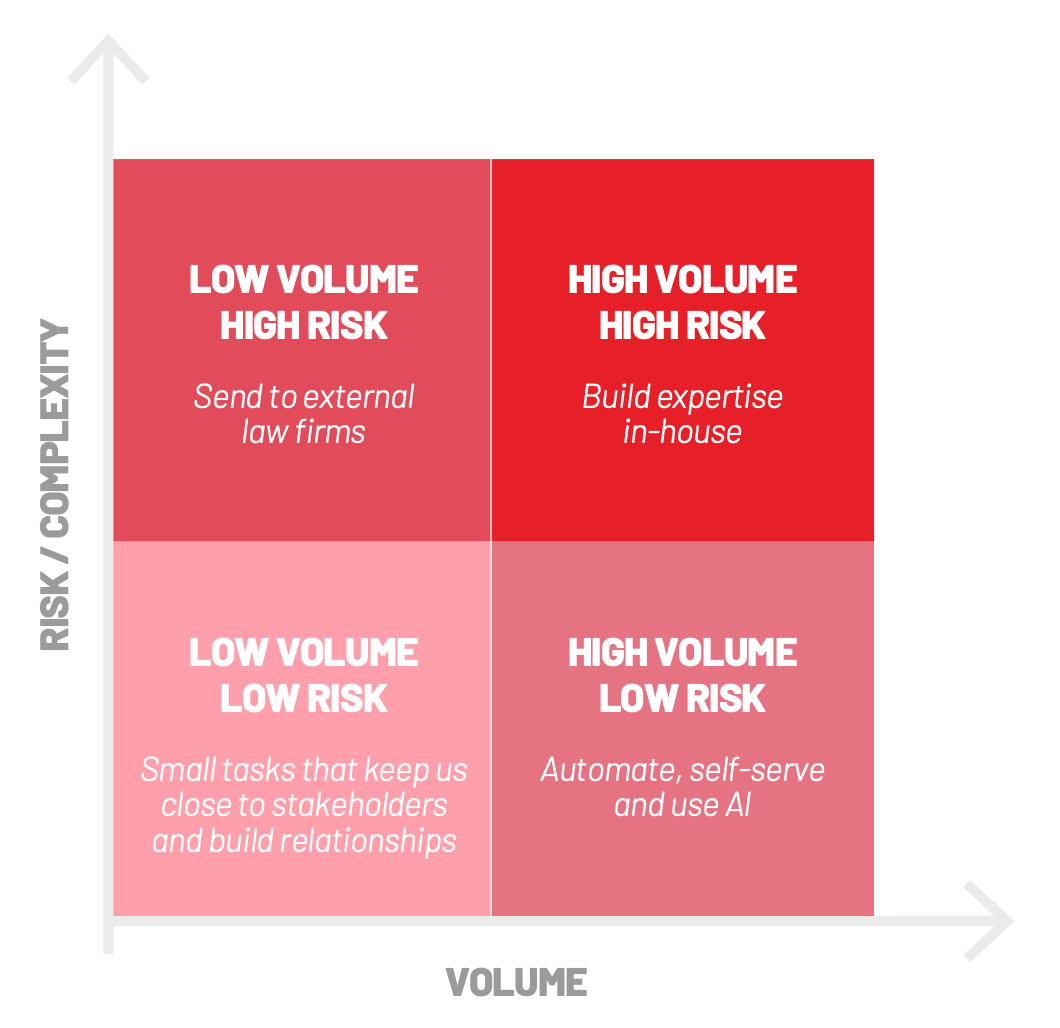
Laura's starting point for AI is not technology. It is the operating model of the legal function. At Utility Warehouse, work is mapped against two dimensions: volume and risk. High-volume, high-risk work justifies specialist capability within the legal team. High-risk, low-volume work can be supported by external counsel. But high-volume, low-risk activity is different: it consumes lawyers' time without making the best use of their judgement. That became the natural territory for process improvement, self-service and AI. The team identified specific pain points—including contract redlining and repetitive business queries—and directed technology towards them, rather than buying AI and searching for somewhere to use it. An AI bot was built within Slack, while other tools tackled contract and reporting workflows. The cumulative effect has been substantial. Laura estimates 2,300 hours saved over twelve months, roughly the capacity of one full-time lawyer. The principle: diagnose the work first. Apply the technology second.
High-risk, low-volume work often requires deep expertise and human judgement. High-volume, low-risk work creates a different challenge. It consumes significant time while often generating relatively little strategic value.
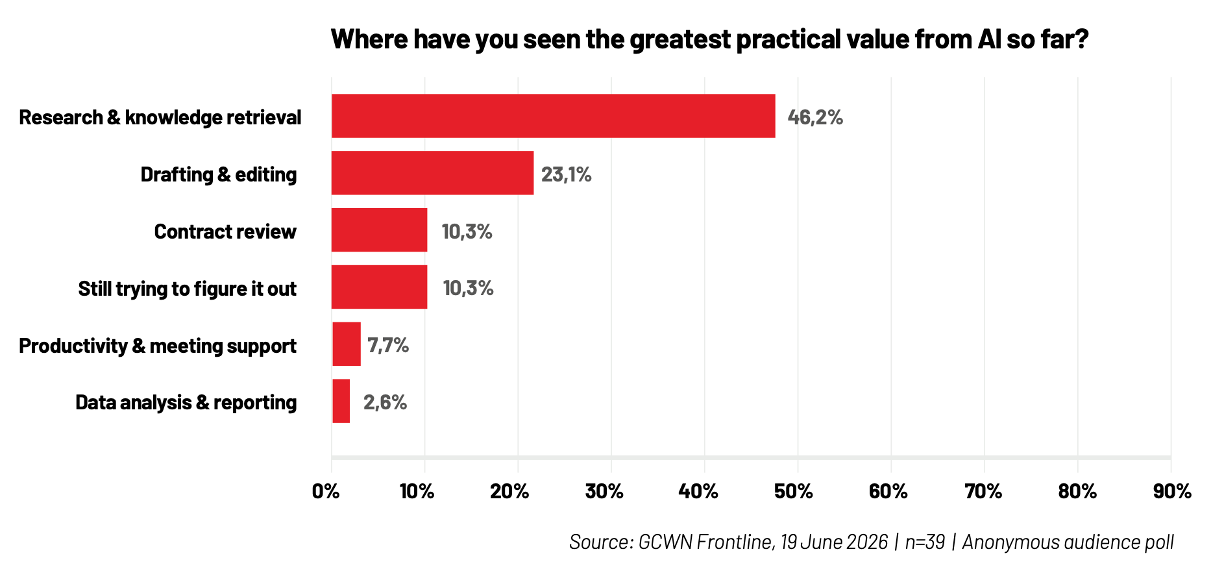
This is where many organisations may find significant opportunity. The poll results reflected this reality. The most common use cases were not futuris- tic applications of AI. They were research, knowledge retrieval, drafting and editing. None of these activities are particularly glamorous. And that is precisely the point.
The first wave of value creation is emerging not from replacing lawyers, but from removing friction. AI may best be viewed as a collaborator rather than a replacement. A sounding board or thinking partner, and a way to accelerate analysis, challenge assumptions and generate options.
Used this way, AI changes where the lawyer's time and expertise are applied. A task that might previously have required several hours to reach a workable first draft can potentially reach that point in minutes, creating more space for questioning, refinement and judgement.
The lawyer as designer
Perhaps the most important leadership lesson emerging from AI adoption is the changing relationship between expertise and learning. Historically, legal careers have rewarded certainty. Clients seek answers, boards expect judgement. Teams look for direction.
AI introduces a different dynamic. No one fully knows where the technology will be in the coming years, even months. New tools emerge almost weekly. Capabilities improve rapidly and use cases continue to evolve. Under these conditions, expertise alone becomes insucient. Adaptability becomes the critical skill.
This is where many of the principles associated with design thinking, innova- tion and entrepreneurship become increasingly relevant to legal leadership.
The design mindset starts from a different premise: we do not need to know the final answer before we begin. We need to understand the problem, test intelligently, learn quickly and redesign as evidence emerges.
Starting small. Prototyping quickly. Learning from failure. Scaling what works. These ideas are not new. What is new is their relevance to legal teams.
Ultimately, AI is an innovation and we know from decades of innovation research that it rarely follows a linear path. It follows that the organisations who will make the greatest progress with AI may not necessarily be the smartest or most technologically advanced. They will be those that bring humility to the learning process, are willing to learn from failure and, crucia- lly, are prepared to do that learning in public rather than private.
The legal sandbox: what legal teams can learn from engineers
Working alongside around 110 engineers has given Fergus a different perspective on experimentation. Engineers, he observed, spend significant time simply playing with things. They follow side projects, test ideas and explore how their skills might allow them to work differently. Crucially, every experiment is not required to have an immediate business case. Instead, ideas are brought into a collaborative space where learning can be shared. The organisation does not begin by demanding that every experiment be monetised or deployed. People are encouraged to “design, develop, experiment” first; the collective can then determine what has value. That mindset contrasts with a profession trained around certainty, precision and getting to the right answer. But in an environment where the technology itself is developing rapidly, waiting for certainty carries its own risk. For legal leaders, curiosity therefore becomes more than an attractive personal characteristic. It becomes an organisational capability: creating permission to explore before knowing exactly where the exploration will lead.
The emerging AI-enabled team
The final audience poll focused on the future. Participants anticipated that AI would have its greatest impact on:
Speed of decision-making
Team structure and skills
Internal stakeholder expectations
Risk and governance
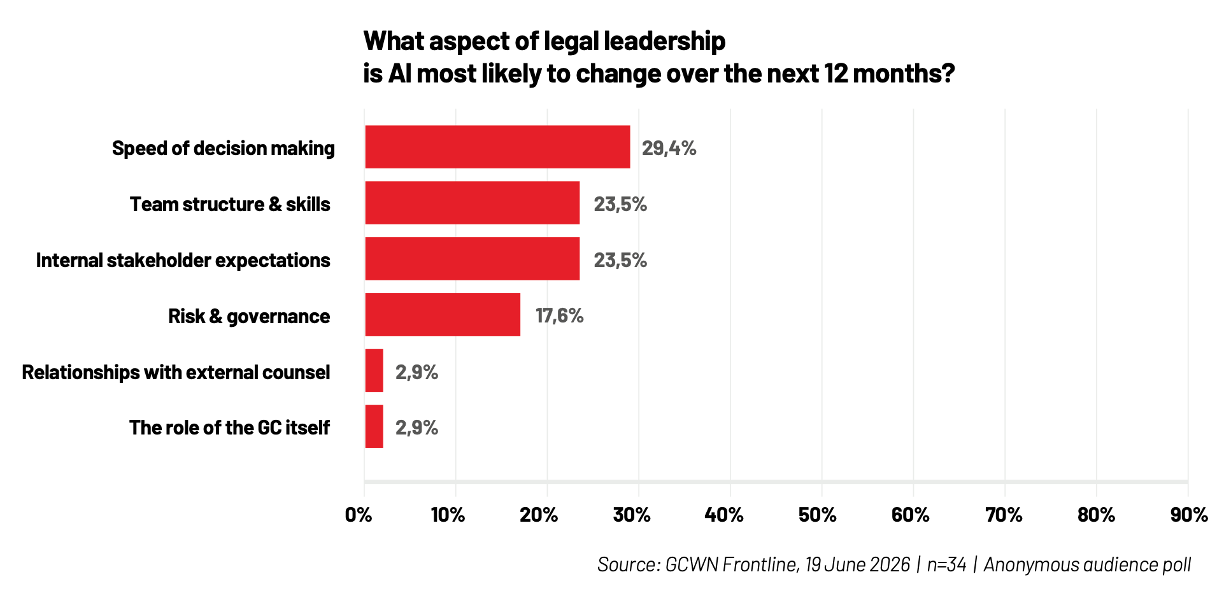
Interestingly, very few believed AI would fundamentally change the role of the General Counsel itself, which deserves closer attention. Much of the public conversation assumes AI will transform the legal profession beyond recognition.
The experience of senior in-house leaders suggests something more nuanced. The role of the GC remains fundamentally rooted in judgement, influence, risk assessment and leadership. What changes is the environment in which those responsibilities are exercised.
This suggests a paradox. The more AI changes the environment around the General Counsel, the more valuable some enduring human capabilities may become. Judgement, influence, curiosity and the ability to lead through uncertainty are not displaced by faster technology; they become more important because of it.
Stakeholders expect faster responses and business leaders arrive with AI-generated analyses, which means that legal teams require new capabilities.
In this sense, AI may be less about replacing legal leadership than increasing the demands placed upon it. The future GC may not perform a fundamentally different role. They may simply be required to perform that role at a very different speed. From our inaugural Frontline session the GCWN community offers several practical actions that may aid these increasing demands.
Focus on behaviour before technology.
Start with a real business problem, not a tool.
Create visible opportunities for experimentation.
Measure value, not activity.
Treat AI as a collaborator, not a replacement.
And these will only work when existing within an environment of curiosity, positive culture and leadership. AI is changing the practice of law. That is undoubted. And those legal leaders who make the best of it will be more curious, more adaptive and more willing to learn in public.
The technology will keep changing. The enduring advantage will belong to legal teams that have learned how to change with it.