Redesigning Legal Leadership: Six themes shaping the future of the General Counsel
The role of the General Counsel is evolving. Legal expertise remains fundamental, but it is no longer sufficient. Today's GC is increasingly a business leader, culture architect, organisational designer, technology adopter and developer of people—all while operating in an environment of almost continuous disruption.
That shift creates enormous opportunity. General Counsel have greater influence than ever before. They are closer to the centre of organisational decision-making and increasingly expected to contribute far beyond the boundaries of law. Yet that opportunity comes with growing pressure and complexity.
Over the first two years of the GC Wellbeing Network, we have had hundreds of conversations with senior in-house legal leaders around the world. Through workshops, peer discussions, interviews and our wider thought leadership, we have gained a privileged view into both the possibilities and pressures of modern legal leadership.
Those conversations build on more than twenty years of work exploring the relationship between wellbeing, leadership, organisational design and performance.
Six themes consistently stand out. They suggest that the next evolution of the General Counsel will not simply be about acquiring more expertise or adopting better technology. It will be about becoming a different kind of leader.
Human Leadership
When the environment becomes uncertain, the temptation is to become more controlling, more reactive and more reliant on what has worked before. Yet uncertainty demands almost the opposite: curiosity, perspective, humility and the willingness to acknowledge that we do not have all the answers.
This is where the idea of heartfulness has become increasingly important in our work. Heartfulness is the ability to remain deeply human under pressure—to stay connected to our values, our judgement and the people around us when circumstances might otherwise push us towards reactivity or survival mode.
For the modern General Counsel, these are not peripheral qualities. Legal training develops formidable analytical capability, but the hardest leadership decisions rarely arrive with perfect information or a single technically correct answer. They require judgement, an understanding of people and context, and increasingly the ability to acknowledge uncertainty while still creating confidence around the way forward.
Humility and vulnerability can therefore be signs of strength rather than weakness. A leader able to say “I don't know” creates space for others to contribute, experiment and learn.
And this extends beyond the individual. How a leader regulates them- selves shapes how others experience them. Calm creates space. Curiosity invites contribution. Humanity builds trust. Over time, these behaviours influence psychological safety, relationships and ultimately culture.
Periods of disruption put leadership capability to the test. The answer is not the solitary expert with all the answers, but leaders capable of bringing out the best judgement in those around them. The more technological our working lives become, the more valuable deeply human leadership may become.
Sustainable Performance
When I published Sustaining Executive Performance in 2014, I proposed a broader way of thinking about sustainability. Alongside the sustainability of organisations and society sat a third dimension, the sustainability of people. My argument was simple: enduring organisations require sustainable leaders. Human performance cannot be separated from the systems in which it takes place.
More than a decade later, that idea has entered the mainstream. Human sustainability is increasingly part of the leadership conversation, accelerated further by questions about what work should look like in an AI-enabled world. But an important distinction remains.
For much of the past twenty years, workplace wellbeing has focused heavily on the individual: exercise, sleep, nutrition, mindfulness, resilience. All matter. But there is a fundamental difference between helping somebody cope with a demanding system and asking whether that system should operate differently in the first place.
The same distinction exists between wellness and wellbeing. Wellness is often something we add to life: the retreat, the app, the gym session, the intervention that helps us recover. Wellbeing is the lived experience itself. It is embedded in how we work, lead and live every day.
This changes the performance conversation. Sustainable performance is not about lowering ambition. Nor is it about using wellbeing techniques to squeeze more from people—a danger when the language of “peak performance” is taken too far. It is about creating the conditions in which high performance can be repeated without progressively depleting the human beings producing it.
At the individual level, that means understanding our own personal operating system: how energy, recovery, physical health, focus, relationships and life beyond work combine to affect the quality of our judgement and leadership. At team and organisational level, it means designing working environments that make sustainable performance possible rather than asking individuals to become ever more resilient to unsustainable conditions.
This matters particularly for the General Counsel. Pressure is inherent in the role, and the objective is not to remove it. Nor can the answer simply be to make GCs better at absorbing more. It is to help leaders—and the organisations around them—make better choices about how that pressure is managed.
It also means building systems capable of absorbing pressure without continually transferring its cost to the people inside them. Sustainable performance is not about enduring more. It is about creating the conditions to perform at a high level, repeatedly, over time.
Culture Architect
The expanding role of the General Counsel brings another opportunity: to shape organisational culture.
Legal occupies an unusual position inside many organisations. It has a horizontal view across functions, geographies, decisions and processes. It sees where friction occurs, where behaviours diverge from stated values and where the right hand of the organisation may not know what the left hand is doing. That creates influence well beyond legal advice.
Within their own teams, the effect is even more immediate. Culture is built through repeated signals. If everything is treated as urgent, the team loses the ability to distinguish what truly matters. If the GC sends messages throughout the night, others infer what commitment looks like. If mistakes are punished, experimentation disappears. If the leader absorbs every important decision, talent stops developing.
The strongest GCs therefore think deliberately about the environment they create around them: clarity of purpose, psychological safety, intelligent delegation, different working preferences and permission to challenge.
Our Vowels of Leadership offer one way of thinking about the behaviours behind that environment: Ambiguity, Empathy, Iteration, Observation and Understanding. Together they encourage leaders to become more comfortable without all the answers, listen for what is not being said, experiment and learn, notice the signals around them and create enough space to understand before acting.
This also means moving beyond the legacy of the heroic leader. We repeatedly hear of GCs caught in a form of pressure sandwich—absorbing demands from above while attempting to protect everyone below. The intention is often admirable. The result can be an exhausted GC and an underexposed team.
Adaptive leadership offers a useful lens here. Rather than keeping di!cult challenges at the top, the leader helps mobilise others to confront them, learn and develop the capacity to respond. A more sustainable model shares responsibility. It gives people problems to solve rather than simply instructions to execute, exposing talented people to more of the challenge and allowing them to develop through tackling it. Leadership becomes less about having all the answers and more about creating the conditions in which others can do their best work.
Operating Model Design
Many of the pressures facing today's legal functions are ultimately design challenges. As expectations grow, simply asking people to work harder—or become more resilient—is not a sustainable answer.
The more useful questions are structural: How does work enter and move through the team? What genuinely requires legal expertise? How are priorities set? Where should decisions sit? What should we stop doing? Where can technology help? And how do we protect the capacity for judgement and strategic thinking?
This represents an important evolution in the wellbeing conversation. Awareness matters, but the next challenge is translating it into workable operating models: clearer communication and intake, realistic capacity management, intelligent prioritisation, psychological safety, protected thinking time and shared responsibility for pressure.
Our work at GCWN increasingly explores these questions through a design lens. Design starts with curiosity rather than certainty. It examines how people actually experience a system, challenges assumptions about how that system should work, and then experiments, learns and adjusts. In our Day in the Life of the GC workshops, for example, we encourage leaders to step away from the relentless flow of execution—to get onto the balcony rather than spending the entire day on the dance floor. That distance creates choices.
The principle applies beyond workflow. Legal functions themselves need to become more adaptive: able to redesign roles, processes, technology and ways of working as demands change. AI makes that imperative even stronger. The opportunity is not simply to automate existing work, but to reconsider what work should be done, by whom, and where human judgement creates the greatest value.
The GC of the future cannot simply become better at absorbing complexity. They will need to redesign the systems through which complexity is managed. The lawyer becomes a designer.
Adaptability
The pace of change facing General Counsel makes adaptability increasingly important. AI is simply the most visible current example.
The technology is moving extraordinarily quickly, yet some of the most interesting lessons emerging from legal leaders are not technological. They are human. Our first GCWN Frontline discussion on AI found widespread adoption but relatively little mature implementation. The teams making progress were distinguished less by the sophistication of their tools than by their willingness to experiment, learn and adapt.
This reflects a broader leadership challenge. McKinsey has described adaptability as a meta-skill: the ability to learn how to learn and apply that learning as circumstances change. The paradox is that precisely when uncertainty makes adaptability most valuable, pressure can drive us back towards familiar behaviours and established answers.
That tension is particularly relevant to lawyers. Legal training understandably rewards expertise, precision and the ability to identify down- side risk. But in genuinely new territory, expertise alone is insufficient. Leaders also need curiosity, humility and a willingness to learn while moving.
AI makes this tangible. A common mistake is to start with the tool: Where can we use AI? A better starting point is the problem. Where is cognitive load unnecessarily high? Where is routine work consuming valuable attention? Where are processes creating friction? Where could technology create more space for judgement, creativity, influence and relationships?
That is partly a design question. But implementation is behavioural. In our Frontline discussion, one legal team moved from an unsuccessful first attempt at AI adoption to asking colleagues simply to use the tool for five minutes each day and share what they discovered. Small behaviours created visibility; visibility built confidence; and experimentation gradually became normal.
There is a wider lesson here about change. Adaptability is not an abstract characteristic. It is something we practise. Habits matter because repeated small behaviours allow new ways of thinking and working to become normal before they need to become heroic. Curiosity can be practised. Reflection can be practised. Experimentation can be practised. So can the ability to notice when an established behaviour is no longer serving us.
This becomes even more important as AI changes the cognitive architecture of work. Recent McKinsey work argues that organisations need to think deliberately about cognitive load, recovery, focus and the human skills that technology should augment rather than erode. Removing routine work may create capacity, but it may also leave people spending a greater proportion of their day on cognitively demanding work. The objective therefore cannot simply be greater efficiency. It must be to preserve and develop the human capacity required to exercise judgement.
The organisations progressing fastest will not necessarily be those that select today's best technology. Technologies will change. The more enduring advantage is the capacity to keep learning and redesigning as circumstances change. In a world where certainty is increasingly scarce, adaptability may become one of the defining capabilities of the modern General Counsel.
Connection & Community
One of the simplest lessons from our first two years has perhaps been the most powerful. The GC role can be lonely.
General Counsel may sit close to the CEO and board while simultaneously leading a team that looks to them for confidence. They may be carrying several highly confidential issues at once, with different groups knowing different fragments of the overall picture.
There are remarkably few places where that person can simply say: I'm not sure. I'm finding this difficult. Has anyone else dealt with something similar?
We have seen repeatedly how quickly the atmosphere changes when senior legal leaders realise they are in a room where the professional mask can come down.
One GC described the pressure created simply by having so few people with whom the complete picture could be shared. They also reflected on how quickly GCWN participants—often people who had never met before—have been willing to speak openly and vulnerably with one another.
That has reinforced something important for us. Peer connection is not simply networking. It is part of the infrastructure of good leadership.
Trusted peers provide perspective, challenge assumptions and remind us that many apparently individual struggles are shared experiences. Sometimes the most valuable intervention is not another piece of content. It is hearing somebody say: I've been there too. Leadership may be personal. It should not be solitary.
A New Model of Legal Leadership
These six themes are deeply interconnected. Human leadership creates trust. Trust enables stronger cultures. Strong cultures make experimentation safer. Experimentation drives adaptability. Better design protects the attention and energy required for good judgement. Connection provides perspective throughout.
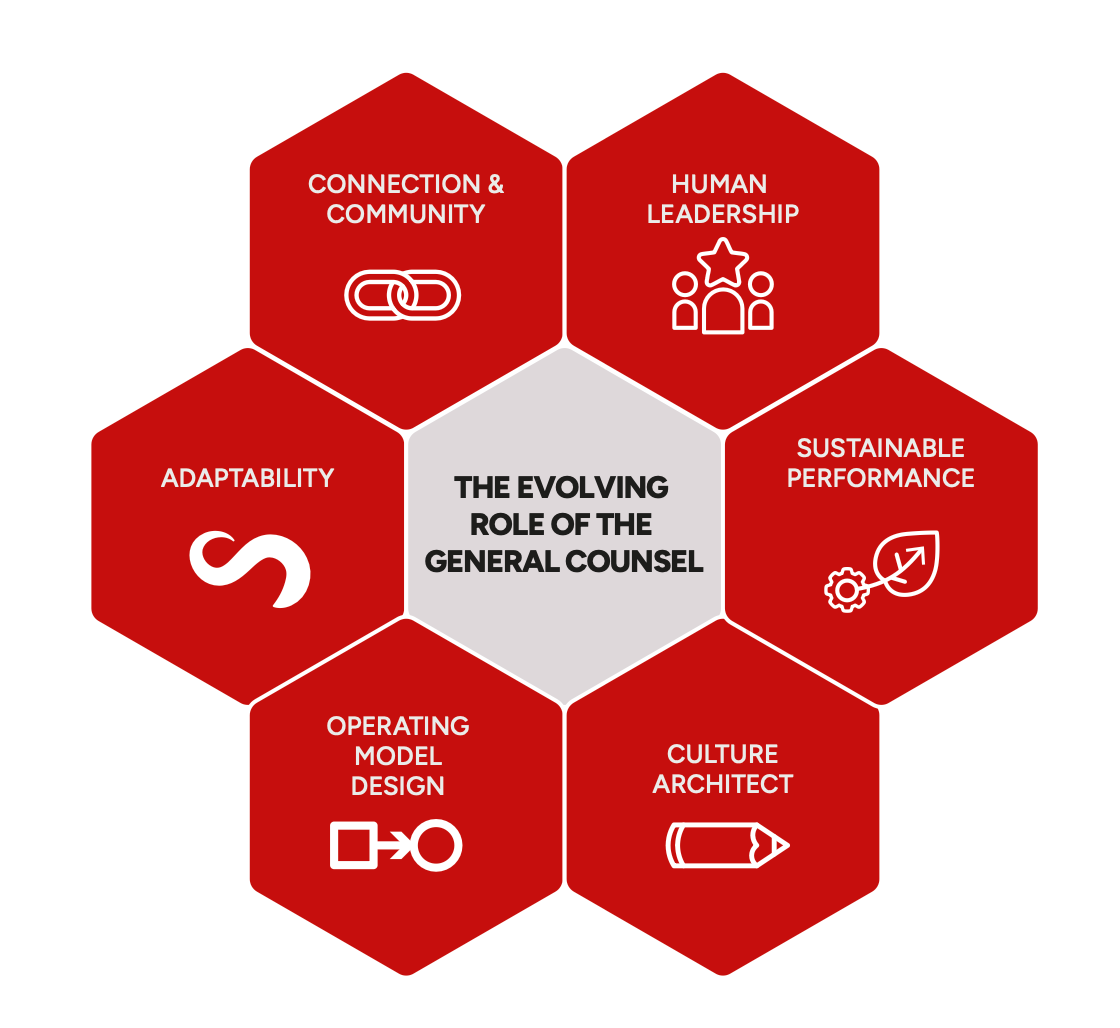
Together, they point towards a broader definition of the modern General Counsel. The GC remains a lawyer, of course. But increasingly they are also an architect of culture, designer of organisations, developer of talent and steward of human performance.
This is also why we believe wellbeing needs to be understood differently. It is not a separate agenda sitting alongside leadership and performance. It runs through them.
Wellbeing influences the quality of our judgement. It shapes the energy we bring into a room. It affects how we respond under pressure, how we treat other people and whether our performance can be sustained over years rather than weeks.
The same applies at team level. A legal function in which people can think clearly, speak candidly, experiment safely and recover properly is not simply a healthier organisation. It is likely to be a better-performing one.
After two years of GCWN, and more than two decades working at the intersection of human wellbeing and organisational performance, this is perhaps the clearest conclusion I would draw: the opportunity is no longer simply to help legal leaders cope with the demands of the role. It is to redesign legal leadership for the world we now inhabit.